Choose a project tool with a five-task pilot, not a feature contest
Use an ordinary piece of work to test ownership, handovers and visibility before your team commits to another app.
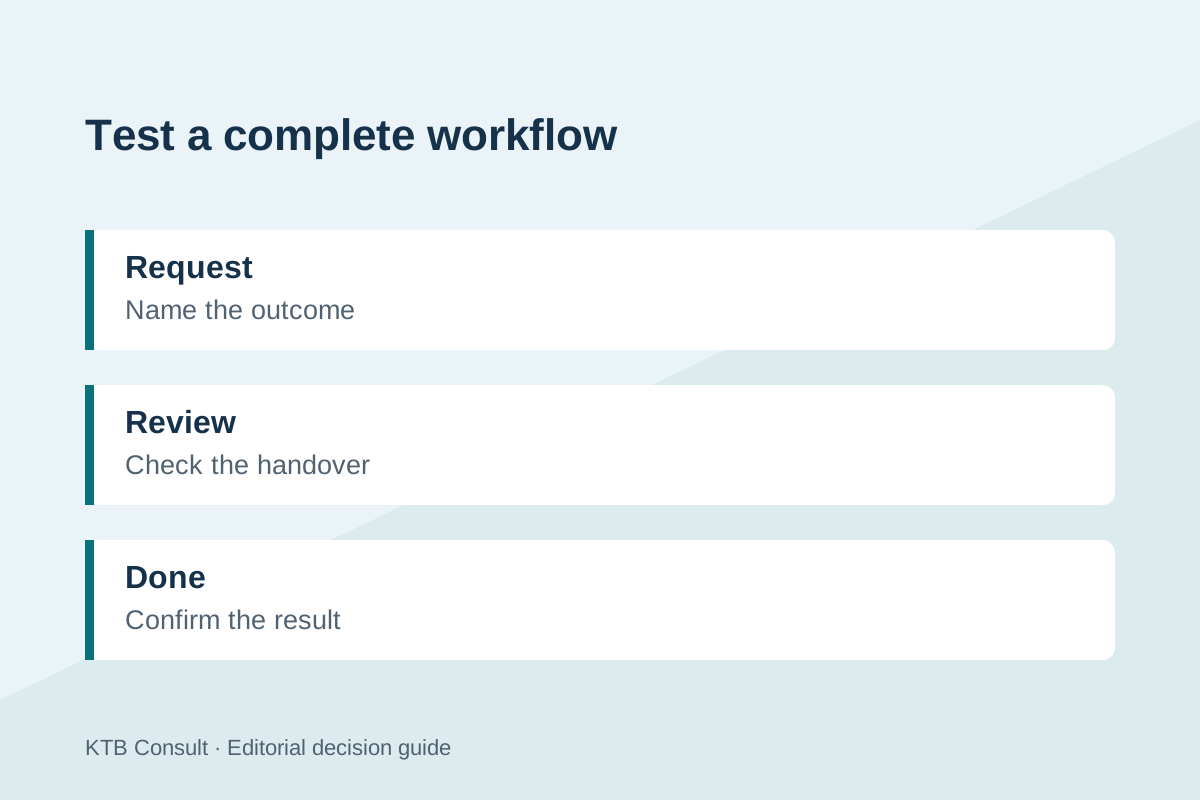
Start here
Pilot a small real workflow with the people who will use the tool. Test whether everyone can see the next action and its owner, then check permissions, exports and the paid tier needed for the workflow.
Pick work that exposes the awkward handovers
A sample marketing launch, client onboarding or monthly newsletter is more useful than an empty demonstration board. Choose five tasks that include a dependency, a review, a file, a deadline and a handover between two people. Use non-sensitive sample data if the provider has not yet passed your access review.
Write down the starting problem. Perhaps requests disappear in chat, approvals arrive late or the team cannot tell who owns a delayed task. A new app should improve that problem. If the difficulty is an unclear decision-making process, changing software alone will not settle it.
Define what a task must contain
Give each task an owner, an intended outcome, a due date where useful and a clear completion condition. A task called Update website is difficult to assess. A task called Publish the approved opening-hours page has a more visible finish. Avoid treating a long list of subtasks as proof that ownership is clear.
Atlassian documents checklists within Trello cards and plan-specific advanced checklist features. That distinction illustrates an important test: can the trial plan represent the level of ownership your workflow needs? If an individual checklist item needs its own responsible person, verify that exact behaviour in the shortlisted plan instead of assuming every checkbox has full task features.
Observe a complete cycle without rescuing it
Ask the team to run the five tasks from request to completion. The person evaluating the tool should watch rather than constantly explain. Record where a colleague cannot find an attachment, misses a handover or needs an extra message to understand the next step. A beautiful dashboard is less valuable if people maintain a second private list to get the work done.
Include one controlled change: move a deadline or return a review for correction. Check what the next person sees, whether notifications are understandable and whether the history explains the change. Do not measure success only by how quickly somebody creates the first task.
Score the workflow and the exit route together
Use a simple scorecard after the pilot: clear ownership, clear next action, useful notifications, acceptable mobile access and manageable administration. Mark each item pass, partial or fail, with one observed example. Ask the quietest participant as well as the most enthusiastic one. Their experience can reveal training or accessibility costs.
Finally, export the pilot and inspect what survives. Trello documents different export formats and limitations; an export button is not a guarantee of an easy move. Check the equivalent rules for each shortlisted product. Select the tool that improves the actual handover problem at a cost the team understands, then agree a review date before expanding it to every project.
| Pilot step | Observation to capture | Pass condition |
|---|---|---|
| Request and assign | Can the next owner find the task? | Owner and next action are clear |
| Review a file | Can the reviewer find the correct version? | No private workaround required |
| Move a deadline | Who sees the change? | Relevant people understand it |
| Export pilot | What survives outside the tool? | Important records remain usable |
Sources and further reading
Source details checked 2026-11-18. Product terms and availability can change; check the relevant seller or provider before ordering.
Editorial guidance, not a claim of hands-on testing. See our editorial policy for how we research guides. Our approach